Cries for Peace in the Nuclear Age
The Cold War sparked multiple peace protests in the UK: from Bertrand Russell and the Campaign for Nuclear Disarmament, to the Greenham Common Women鈥檚 Peace Camp.


The Cold War threat of nuclear annihilation sparked a series of iconic protest movements in the UK. But whilst the 麻豆社 helped to convey the disarmament message to a wider public through its reporting, did anyone in authority truly listen? And if so, to what effect?
The Campaign for Nuclear Disarmament (CND) was launched in 1957 to challenge the Cold War鈥檚 logic of 鈥榤utually assured destruction鈥�. Its now universally-recognised logo, juxtaposing the semaphore letters N(uclear) and D(isarmament), was designed by Gerald Holtom, a World War Two conscientious objector, and symbolised his fears:
I drew myself: the representative of an individual in despair, with hands palm outstretched outwards and downwards in the manner of Goya鈥檚 peasant before the firing squad.
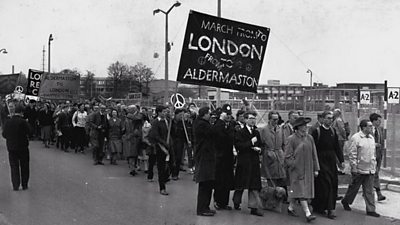
CND soon gained prominence thanks to the protest march from London to the UK鈥檚 weapons research centre at Aldermaston, Berkshire, in 1958. A shift to more direct action in 1961 saw 4,000 CND demonstrators stage a sit-in outside the Ministry of Defence in London鈥檚 Whitehall, with over 1,500 arrested at Trafalgar Square. At Holy Loch on Scotland鈥檚 west coast, 350 protestors were also being gaoled for challenging the establishment of an overseas base for American submarines armed with ballistic missiles.
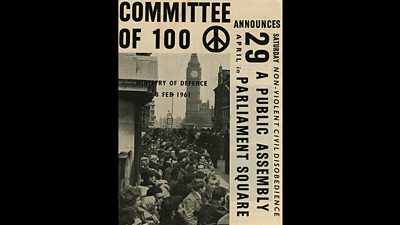
Amongst those imprisoned was 89-year-old philosopher Bertrand Russell. For Russell, and the Committee of 100, non-violent direct action was necessary to capture media interest, and breaking the law was justified to counter the far greater offence of nuclear war planning. In 1963, an off-shoot of the Committee of 100, Spies for Peace, revealed secret government preparations for nuclear war, including plans to police a devastated post-attack population. The story made headline news, but the press was quickly muzzled by a D notice (D for defence), where the government could cite national security to suppress information.
-
Policy statement of the Committee of 100, with thanks to the British Library.
Clearly, being heard was a challenge, but a group of young people were invited to contribute to 麻豆社 2鈥檚 long-running Let Me Speak show, hosted by the renowned journalist and broadcaster, Malcolm Muggeridge. Aired on Aug 1st 1964, they indignantly declared to bleary-eyed viewers still tuned in to the day鈥檚 final programme:
We're tired of seeing the disarmament talks get virtually nowhere at all while more and more nations plan to get nuclear weapons. We're sick to death of hearing all those fatuous clich茅s about the Communist menace and the need for Western unity.
Was anyone listening? More than 20 years later in 1988, a 麻豆社 retrospective of the Aldermaston march similarly asked, 鈥榙id anyone in authority hear the chants of 鈥楤an the Bomb鈥�? It would seem not. Having already been dubbed the Iron Lady by Soviet commentators, Margaret Thatcher became prime minster in May 1979. In December, NATO opted to deploy American Pershing ballistic and Tomahawk cruise missiles in Western Europe to counter newly-developed Soviet weapons. Within days of this announcement, Soviet troops invaded Afghanistan, and US President Jimmy Carter called a halt to ongoing arms limitation talks. Within a year, Ronald Reagan had become US president, quickly bonding with like-minded Thatcher and in 1980, the UK opted to purchase the American Trident nuclear missile system. The Cold War was getting hotter.
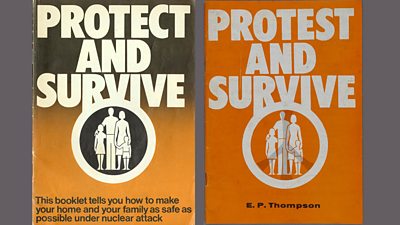
European Nuclear Disarmament (END) was born in 1980 under the threat of 鈥榣imited鈥� nuclear war between the superpowers across European territory. Urging the continent to join forces for peace 鈥榝rom Portugal to Poland鈥�, END distinctively called on the USSR to disarm alongside the West. Equally daring was its concept of 鈥榙茅tente from below鈥�:
"The remedy lies in our own hands . . . We must commence to act as if a united, neutral and pacific Europe already exists. We must learn to be loyal, not to 鈥楨ast鈥� or 鈥榃est鈥�, but to each other, and we must disregard the prohibitions and limitations imposed by any national state . . ."
END quickly secured support from within the Soviet bloc, including former Hungarian prime minister Andras Hegedus and Russian dissident Roy Medvedev. It encouraged visits between country 鈥榳orking groups鈥�, and support for dissidents, including V谩clav Havel in Czechoslovakia. Such dissidents in turn educated Western activists about the power of Soviet propaganda, and life under Soviet totalitarianism.
Yet whilst the 麻豆社 invited END founders, including E.P. Thompson and Mary Kaldor, to debate, for example on Any Questions, END鈥檚 citizen diplomacy rarely grabbed the headlines. One exception was the furore in 1981 after Thompson was sounded out about鈥� but not offered 鈥� the annual televised Richard Dimbleby lecture. In his oral history interview, undertaken by Frank Gillard in 1983, the corporation鈥檚 then Director-General Ian Trethowan recounted:
"... it was said that E.P. Thompson had been signed up for the Dimbleby Lecture鈥� and that I had in my 'fascist and dictatorial鈥� way stopped this great .. great nuclear disarmer from... saying to the nation what it was about. In fact鈥� it was perfectly clear that he knew that it was a sounding, it was not an actual engagement. Well as soon as I saw his name I said 'You must be mad you can't put this chap on, he is a rabid nuclear disarmer'. I said 'He is a very distinguished historian if you want to put him on the list as a historian ..three cheers... Anyhow there was a great public fuss and I was much belaboured as being brutal and repressive as an editor."
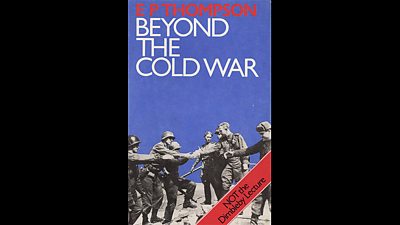
In the end, Thompson had his say, delivering his 鈥楴ot the Dimbleby Lecture鈥� in Worcester, in which he argued that conflicts had become systematized, in 鈥榓 鈥榮elf-reproducing鈥� dynamic condition which, while postponing war, also postponed indefinitely the resolutions of peace鈥�.
END鈥檚 vision aimed to challenge the propagandising on both sides of the Cold War divide that promoted theories of nuclear deterrence, which were opposed to unilateralism. And it seemed in 1981 that the message might be gaining ground when the Labour Party adopted a nuclear-free defence policy, despite a Gallup poll suggesting widespread uncertainty about unilateralism. In 1982, the 麻豆社鈥檚 Panorama speculated on the prospects of this policy, wondering: 鈥楽ense or Suicide? Is pulling down the nuclear umbrella the route to peace, or an invitation to war?鈥�
In the event, Labour suffered a heavy General Election defeat in June 1983, blamed in part on its unilateralist commitment, although the newly formed SDP-Liberal Alliance helped split the anti-Conservative vote. Yet at the same time, President Reagan鈥檚 Star Wars initiative 鈥� designed to intercept incoming Soviet missiles in mid-air 鈥� helped fuel a CND revival, and mobilised mass demonstrations. Moreover, a new peace campaign was capturing the public鈥檚 imagination in ways that were unique and spectacular: The Greenham Common women鈥檚 protest.
In September 1981, a small group of women, plus a few men and children, arrived at Greenham Common Royal Air Force base in Berkshire, to deliver a letter. 鈥榃e鈥� have walked one hundred and twenty miles from Cardiff鈥�, it began:
"We fear for the future of all our children, and for the future of the living world which is the basis of all life. We have undertaken this action because we believe that the nuclear arms race constitutes the greatest threat ever faced by the human race and our living planet. We have chosen Greenham Common as our destination because it is this base which our Government has chosen for 96 鈥楥ruise鈥� [missiles] without our consent."
The Commandant invited them to stay, hospitality he surely came to regret: thus, the peace camp was established. There was little media reaction at first, nor when four women chained themselves to the fence, suffragette-style, demanding a televised debate with Defence Secretary, John Nott. Despite considerable correspondence with 麻豆社 and ITV producers, no debate took place.
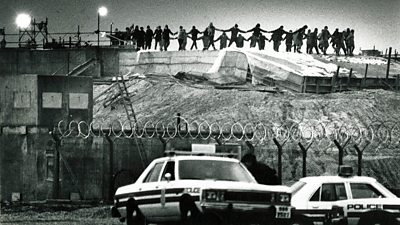
Yet over time, the camp would mesmerise the media with its women-led direct action, and tactics which 鈥� in addition the unusual but effective handwritten chain letter sent through feminist networks 鈥� culminated in the legendary 鈥楨mbrace the Base鈥� protest in 1982, when 30,000 women joined hands around the 11-mile perimeter fence. Sympathy for the cause soared, with a Marplan Survey showing 66% of women and 55% of men supporting nuclear disarmament.
And Greenham women learned to use the media: favouring women journalists, photographers and lawyers to confront the dominance of men in those fields. Its most famous record was Raissa Page鈥檚 photograph of 44 women dancing on a missile silo at dawn on New Year鈥檚 Day, 1983. Page, from the pioneering all-women鈥檚 photography agency, Format, was quietly invited to witness the break-in, which refuted the government鈥檚 assertion that Greenham was the most secure base in Europe.
But such media successes came at a price, especially after Michael Heseltine became Defence Secretary in 1983. Charged with leading a counter-information campaign, he quickly set up a small propaganda team to brief opinion-formers, schmooze journalists, and counter the disarmament message. Groups such as Women & Families for Defence, led by Lady Olga Maitland, who later served as a Conservative MP, worked to undermine the feminist message in particular. Rebecca Johnson, who lived at Greenham for five years, commented:
"We鈥檇 gone from being, you know, these wonderful... housewives, mothers, grandmothers, to being this... aggressive rabble of dykes. And again, that was one of the first times that you just saw the media using this... pejorative sort of labelling of us as lesbian to 鈥� to somehow dismiss us or to try to get the people out in the public to see us as something less than human or certainly less than womanly."
Yet by December 1987, Presidents Reagan and Gorbachev had agreed an intermediate-range nuclear forces (INF) treaty, banning all land-based ballistic and cruise missiles. Greenham鈥檚 missiles were removed in 1989 and the site reverted to common land in 2000. Such change was surely in part thanks to the efforts of millions of peace protestors on both sides of the Iron Curtain.
Greenham鈥檚 anarchic community and inclusive politics 鈥� protesting against nuclear testing in the Pacific and uranium mining in Namibia, as well as patriarchal militarism 鈥� perhaps made it easy to mock. But Greenham was not just a lifestyle experiment. As with CND and END, it was a brave attempt to promote direct action, citizen diplomacy, and utopian dreams.
Such dreams were shaped and reshaped by an existential terror which drove people to protest. Yet there has been far greater nuclear proliferation since the supposed end of the Cold War. END founder Mary Kaldor theorises current 鈥榥ew wars鈥� as spreading and persistent, in a globalized war economy. In this context, the UK is not removed but involved, through terror management, arms trading, and nuclear arms hosting and development. And on 1 February 2019, US President Trump formally suspended the hard-won Intermediate-Range Nuclear Forces Treaty. The following day, Russia did so too.
So, we must continue to ask 鈥� who in authority is listening?
Written by Professor Margaretta Jolly, University of Sussex.
Further Reading
With thanks to the British Library for use of materials relating to Sisterhood and After: The Women鈥檚 Liberation Oral History Project, at bl.uk/sisterhood and to the Committee of 100, at Dreamers and Dissenter.
Johnson, R. 2009. Unfinished business: the negotiation of the CTBT and the end of nuclear testing, Geneva, UNIDIR.
Kaldor, M. 2012. New and old wars: organized violence in a global era, Cambridge, Polity.
Montgomery, V. L. 1956. The Panorama of Warfare in a Nuclear Age. Royal United Services Institution, 101, 503-520.
Smith, D. 1980. The European Nuclear Theatre. In: E.P.THOMPSON & SMITH, D. (eds.) Protest and Survive. Harmondsworth: Penguin.
Jones, L. 1983. Keeping the peace, London, Women's Press.
Roseneil, S. 2000. Common women, uncommon practices: the queer feminisms of Greenham, London, Cassell.
Thompson, E.P. & Smith, D. (eds.) 1980. Protest and Survive. Harmondsworth: Penguin.
Thompson, E. P. 1982. Beyond the Cold War, London, Merlin Press jointly with END.
Young, A. 1990. Femininity in dissent, London; New York, Routledge.
The Cold War elsewhere on the 麻豆社
Search by Tag:
- Tagged with Cold War Cold War
- Tagged with 100 Voices 100 Voices