Aftermath
Texts and music reflecting a world changed by war, with readings by James Wilby and Helen Baxendale. With Elgar, Ravel, Tippett, Sassoon, Kipling, Pat Barker and Woodrow Wilson.
From shellshock to women's suffrage, homecomings to war memorials, the League of Nations to Spanish flu, a sequence of poems, prose and music reflecting a world changed by war. James Wilby and Helen Baxendale read poems by Sassoon, Whitman and Gurney and excerpts from Pat Barker, Woodrow Wilson and contemporary documents, while the music includes works by Elgar, Ravel and Tippett.
Last on

Music Played
Timings (where shown) are from the start of the programme in hours and minutes
-
Sebastian Faulks
Birdsong, read by James Wilby
![]() 00:01
John Foulds
Requiem aeternam (A World Requiem)
Performer: Gerald Finley (baritone), Crouch End Festival Chorus, Philharmonia Chorus, 麻豆社 Symphony Chorus, 麻豆社 Symphony Orchestra, Leon Botstein (conductor).- Chandos CHSA5058.
- CD1 Tr1.
Letter by Private Charles T. Green, King聮s Royal Rifle Corps
Read by James Wilby
![]() 00:11
Bob Chilcott
Everyone Sang
Performer: Wellensian Consort, Christopher Finch (conductor).- Naxos 8.573158.
- Tr3.
William Alexander Percy
Poppy Fields 聳 France, 1918, read by Helen Baxendale
![]() 00:14
Maurice Ravel
Fugue (from 聭Le Tombeau de Couperin聮)
Performer: Steven Osborne (piano).- Hyperion CDA 677312.
- CD2 Tr2.
Ivor Gurney
To his Love, read by James Wilby
![]() 00:18
Edward Elgar
Cello Concerto in E minor, Op. 85 (1st movement) (excerpt)
Performer: Jacqueline Du Pr茅 (cello), London Symphony Orchestra, John Barbirolli (conductor).- EMI CDC 747 3292.
- Tr1.
Charlotte Mew
The Cenotaph, read by Helen Baxendale
![]() 00:27
Gustav Holst
Ode to Death (excerpt)
Performer: London Symphony Chorus, Richard Hickox (conductor).- Chandos CHAN 2416.
- CD2 Tr10.
Woodrow Wilson
Speech in favour of the League of Nations. Pueblo, 25 September 1919 (excerpt). Read by James Wilby
![]() 00:35
George and Ira Gershwin
The League of Nations (from 聭Of Thee I Sing!聮)
Performer: New York Choral Artists, Orchestra of St Lukes, Michael Tilson Thomas (conductor).- CBS M2K 42522.
- CD2 Tr17.
Anna Eisenmenger
Blockade 聳- The Diary of an Austrian Middle-Class Woman 1914-24, read by Helen Baxendale
![]() 00:39
Dmitry Shostakovich
Symphony No. 12 聭'The Year 1917' (3rd movt) (excerpt)
Performer: Royal Liverpool Philharmonic Orchestra, Vassily Petrenko (conductor).- Naxos 8.572658.
- Tr6.
Anon
Influenza, read by Helen Baxendale
![]() 00:40
Essie Jenkins
Influenza Blues
Performer: Essie Jenkins (voice).- Arhoolie CD510.
- Tr8.
Walt Mason
The Influenza, read by James Wilby
Siegfried Sassoon
Survivors, read by Helen Baxendale
![]() 00:45
Bruce Springsteen
Turn out the Light
Performer: Bruce Springsteen.- Columbia 492 605 2.
- CD2 Tr17.
Gilbert Frankau
Peter Jameson -聳 A Modern Romance, read by Helen Baxendale
![]() 00:51
Yip Harburg & Jay Gorney
Brother, can you spare a dime?
Performer: Bing Crosby, Lennie Heyton and his orchestra.- ASV CDAJA 5183.
- Tr16.
Pat Barker
Toby聮s Room (excerpt), read by Helen Baxendale
![]() 00:00
Benjamin Britten
Offertorium (from 聭A War Requiem聮) (excerpt)
Performer: Philip Langridge (tenor), John Shirley-Quirk (baritone), Choristers of St Paul聮s Cathedral, London Symphony Chorus, London Symphony Orchestra, Richard Hickox (conductor).- Chandos CHAN 8983/4.
- CD1 Tr3.
Siegfried Sassoon
At the Cenotaph, read by James Wilby
![]() 01:04
Michael Tippett
The world turns on its dark side (from 聭A Child of Our Time聮)
Performer: London Symphony Chorus, London Symphony Orchestra, Colin Davis (conductor).- LSO LIVE LSO 0670.
- Tr1.
Walt Whitman
Reconciliation, read by James Wilby
Producer Note
For this final part of our trilogy of Words and Music in the Great War, we have followed on from 鈥極utbreak鈥� and 鈥楧isplacement鈥� to explore the legacy of war in 鈥楢ftermath鈥�.聽It鈥檚 a big subject;聽indeed, who鈥檚 to say where it ends?聽Nearly 100 years after the First World War, we are still living in its shadow, rerunning it in our minds in an uneasy combination of fascination and horror.聽Its long political reach continues to shape our world today, and its emotional scars still haunt us.
To keep it within some sort of bounds, I鈥檝e picked a clutch of issues that affected the first postwar decades.聽They include timelessly repeating states of mind such as mourning, reconciliation, hope for a better world and disillusionment, but also focus on others more specific to the decades following the Great War, such as the 1919 Spanish flu pandemic, shellshock and facial disfigurement.
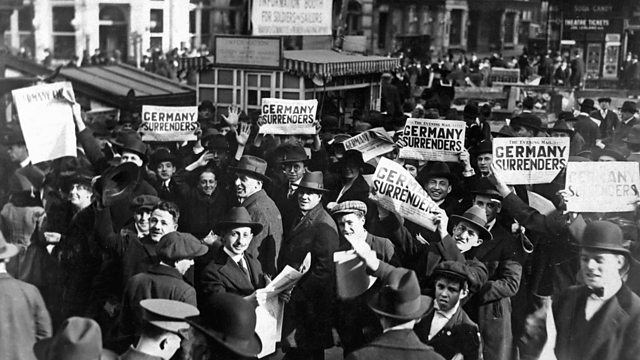
Relief followed by mourning were understandably the most immediate reaction to the November 1918 armistice, and the programme opens with Sebastian Faulks鈥檚 memorable description of a dazed and drained Stephen Wraysford, the central character of his hugely popular novel Birdsong, surfacing from days trapped underground to find the war over and the battlefield deserted. Bob Chilcott鈥檚 choral setting of Siegfried Sassoon鈥檚 armistice poem Everyone Sang offers a more grateful response, if still tinged by sadness and regret.聽In between come the moving opening chorus of John Foulds鈥檚 solemnly pacifist World Requiem, composed in a rush of emotion in the last months of 1918, and first heard at a massive remembrance service in the Royal Albert Hall in 1923.聽There is also a short extract from a private soldier鈥檚 letter home, looking forward to a quiet homecoming with no questions.
Many minds were exercised in the immediate postwar period as to how the millions of war dead could most fittingly be memorialised.聽This was when the Tomb of the Unknown Soldier, the Commonwealth War Graves and several hundred village war memorials came into being 鈥� not without controversy, as it happens 鈥� and the poems I have chosen by William Alexander Percy, Ivor Gurney and Charlotte Mew, while earnest in their compassion, are each mindful in their own way of over-simplification of remembrance.聽They are complemented by musical elegiacs by Ravel, Elgar and Holst.
Hopes of a new and better world surface in a diary account by 鈥楢n Austrian Middle-Class Woman鈥� documenting her son鈥檚 new-found egalitarianism, fired by anger at society鈥檚 upper echelons, and in a section from one of President Woodrow Wilson鈥檚 speeches in favour of the establishment of the League of Nations, an organisation which sadly failed to achieve its aims, and whose proposals, intended to put the brakes on irresponsible warmongering, today seem if anything further than ever from being realised.聽聽
What joy and relief there was at the end of hostilities was brief for some when a Spanish influenza pandemic took a further 50-100 million lives in 1918-9.聽The responses I have found to it may be essentially light-hearted, but it is black humour none the less.聽聽
Many who survived both war and flu, however, went on to live blighted lives, either as a result of shellshock, the condition now known as combat stress reaction which was only then beginning to be understood.聽Siegfried Sassoon saw shellshock sufferers at first hand during his own recuperation period at Craiglockhart War Hospital, and pictured them memorably in his poem 鈥楽urvivors鈥�, while Gilbert Frankau, an interwar campaigner for shellshocked servicemen, made one the eponymous main character of his novel Peter Jameson.聽Their evocations of the terrors that never go away, even when combat itself is a distant memory, are complemented by Bruce Springsteen鈥檚 post-Vietnam song Turn out the Light.聽A world where heroes鈥� deeds are soon forgotten and the little man overlooked once more is evoked in one of the 1930s鈥� most poignant popular songs, 鈥楤rother, can you spare a dime?鈥�, before an extract from Pat Barker鈥檚 2012 novel Toby鈥檚 Room depicts the shattered life of one of the many soldiers whose survival came at the expense of terrible and debilitating facial disfigurement.
After all this, and looking around at the constant state of conflict in the world today, it was hard to end in optimistic vein.聽聽 The Offertorium from Benjamin Britten鈥檚 War Requiem, troped by Wilfred Owen鈥檚 poem outlining a tragic alternative ending to the Biblical story of Abraham and Isaac, hammers home how often we waste lives even when given the chance not to;聽Sassoon鈥檚 Cenotaph meditation reveals his fears for a dark future;聽 and the opening chorus from A Child of our Time, Michael Tippett鈥檚 聽Second World War oratorio inspired by Nazi pogroms, bleakly depicts a world 鈥榯urning on its dark side鈥�.聽聽 Yet I have at least chosen to end on a quiet note of hope, with a poem by Walt Whitman written in the aftermath of the American Civil War, celebrating one positive course that will always be open to us 鈥� reconciliation. 聽
Lindsay Kemp
Producer
Broadcast
- Sun 6 Jul 2014 17:30麻豆社 Radio 3
The hidden history of plant-based diets
![The hidden history of plant-based diets]()
Forget social media influencers - the meat-free movement started with the Victorians.
Books website
Get closer to books with in-depth articles, quizzes and our picks from radio & TV.
Gallery
Related Content