Cat Tales: In from the Wild
The latest archaeology and genetics answer the biggest questions about our cats. Where do they come from? Why do we love them? What鈥檚 going on inside their heads?
In this episode, we take a close-up look at the world鈥檚 most popular furry pet, the cat. Detailed real-time brain scans reveal a possible explanation for why owners are besotted with their cats. A cat鈥檚 meow plugs straight into the emotional centres of our brains in exactly the same way as a baby鈥檚 cry. And adult cats only meow to humans. So they may not intend to manipulate us, but they do. It turns out owners literally can鈥檛 help loving their cats.
Can we tell what a cat is thinking and feeling? In a way, we can. Dr Lauren Finka has been studying cats鈥� enigmatic faces to try and read their thoughts and emotions. 鈥榃hilst cats definitely change their expressions, it's very, very subtle. For the average cat owner trying to look at the cat's face, it remains problematic.' So, unless you鈥檙e a scientist, cats remain hard to read.
By contrast, according to new research, it turns out that cats can read our emotions like a book.
We discover that the gap between our lovable pets and wildcats is paper-thin. So how did we end up with a wild animal living in our homes?
We meet vet Dr Ashlie Randal, who is working with domestic cats that have turned wild 鈥� feral cats. 'Feral cats are very different from domestic cats. They typically will fight or resort to flight when people come into play.' And yet, genetically, they are identical to your furry pet.
So what鈥檚 the origin of our nearly wild pets? Geneticist Carlos Driscoll explains how his research found their wildcat ancestors are Felix Silvestris Lybica, the North African wildcat. 'People have been speculating about it for hundreds of years. Now with the advent of molecular genetic techniques, we can really drill down and say definitively where domestic cats come from.'
Archaeology has pinpointed one of the earliest ever pet cats - the moment when human met cat 9,500 years ago. It was found in an ancient Cypriot burial by archaeologist Jean-Denis Vigne. 'They were facing each other in death. In the afterlife. And this is a scene that has been arranged by people.'
Using graphics and interviews, we reveal that what drew cats and humans together was a change in human behaviour - the beginning of agriculture. It attracted cats out of the wild and into human settlements.
The story of the pet cat takes an unexpected twist, one thousand miles and several thousand years away in Egypt. Things seemed to look up for cats as the ancient Egyptians turned them into gods. But Egyptologist Salima Ikram uncovers a trove of cat mummies to reveal the unpleasant downside of the Egyptian obsession with cats. 'Pilgrims would buy these cats to give a blood sacrifice.'
Things didn鈥檛 improve for Egyptian cats in Europe during the Middle Ages. It was all the fault of Pope Gregory IX, who said that cats were in league with Satan. Medieval expert Ronald Hutton paints a ghastly picture. 'In late medieval Europe, there were festivals formed around the torturing and killing of cats, regarding cats as essentially, nosy, menacing, intrusive, potentially satanic beings.'
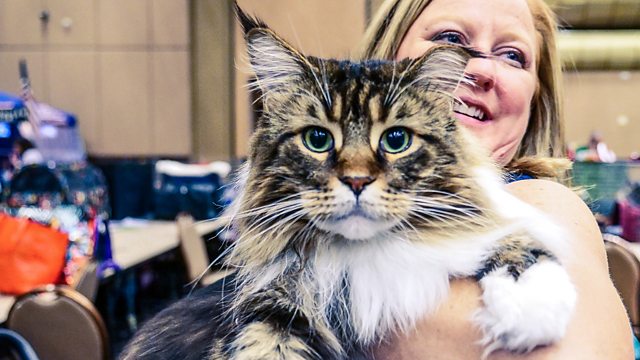
But in the 21st century, the life of a cat has really turned around. They are now the most popular furry pet in the world. We visit Las Vegas鈥檚 largest cat show to see just how far the cat has come.
We also find out if it鈥檚 really true that you can鈥檛 train a cat. According to Samantha Martin of Acro-Cats, you actually can: 'Cats are brilliant. People really underestimate the brilliance of cats. By training them, they get to use their brain.'
So what鈥檚 next for the cat? We meet owners who are cross breeding other wildcats with domestic cats to create completely new species. Ironically, they鈥檙e trying to make domestic cats look wild, which under the skin of course, they still are.
What do cats make of all this? As usual, they鈥檙e not saying.
Last on

Clip
-
![]()
Manipulative meowing
Duration: 01:06
Credits
| Role | Contributor |
|---|---|
| Narrator | Mark Benton |
| Expert | Morten Kringelbach |
| Expert | Lauren Finka |
| Expert | Leslie Lyons |
| Expert | Sarah Ellis |
| Expert | Carlos Driscoll |
| Expert | Jean-Denis Vigne |
| Expert | Salima Ikram |
| Director | Peter Chinn |
| Producer | Lucile Smith |