Mitridate, re di Ponto
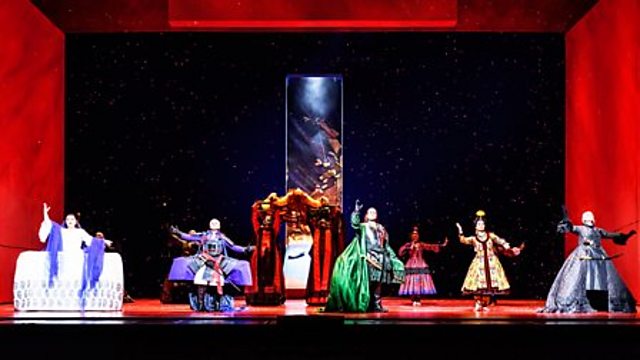
Mozart's early opera seria, Mitridate, re di Ponto, in a famous production by Graham Vick. Christophe Rousset conducts. Michael Spyres sings the title role.
Kate Molleson and Martin Handley introduce Mozart's Mitridate, Re di Ponto, recorded in 2017 at the Royal Opera House in London.
Mozart was 14 when he wrote this early opera seria masterpiece telling the tragic story of the King of Ponto, a warrior whose sons Farnace and Sifare are in love with his fianc茅e Aspasia, which leaves them torn between loyalty to him or betrayal with the enemy.
In this highly acclaimed production, Christophe Rousset conducts the ROH Orchestra and chorus, as well as a stellar cast lead by Michael Spyres in the title role, Albina Shagimuratova as Aspasia, Bejun Mehta as Farnace and Salome Jicia as Sifare.
During the interval: a tribute to the late Sir Graham Vick, director of this production. Kate Molleson talks to Alpesh Chauhan and Anna Picard about the man and his legacy.
Mitridate ..... Michael Spyres (tenor)
Aspasia ..... Albina Shagimuratova (soprano)
Sifare ..... Salome Jicia (soprano)
Farnace ..... Bejun Mehta (counter-tenor)
Ismene ..... Lucy Crowe (soprano)
Marzio ..... Rupert Charlesworth (tenor)
Abate ..... Jennifer Davis (soprano)
Royal Opera House Orchestra
Christophe Rousset (conductor).
Last on

More episodes
Previous
Next
Music Played
-
![]()
Wolfgang Amadeus Mozart
Mitridate, re di Ponto (Act 1)
Singer: Michael Spyres. Singer: Albina Shagimuratova. Singer: Salome Jicia. Singer: Bejun Mehta. Singer: Lucy Crowe. Singer: Rupert Charlesworth. Singer: Jennifer Davis. Choir: Royal Opera House Chorus. Orchestra: Orchestra of the Royal Opera House, Covent Garden. Conductor: Christophe Rousset. -
![]()
Wolfgang Amadeus Mozart
Mitridate, re di Ponto (Act 2)
Singer: Michael Spyres. Singer: Albina Shagimuratova. Singer: Salome Jicia. Singer: Bejun Mehta. Singer: Lucy Crowe. Singer: Rupert Charlesworth. Singer: Jennifer Davis. Choir: Royal Opera House Chorus. Orchestra: Orchestra of the Royal Opera House, Covent Garden. Conductor: Christophe Rousset. -
![]()
Wolfgang Amadeus Mozart
Mitridate, re di Ponto (Act 3)
Singer: Michael Spyres. Singer: Albina Shagimuratova. Singer: Salome Jicia. Singer: Bejun Mehta. Singer: Lucy Crowe. Singer: Rupert Charlesworth. Singer: Jennifer Davis. Choir: Royal Opera House Chorus. Orchestra: Orchestra of the Royal Opera House, Covent Garden. Conductor: Christophe Rousset.

Synopsis
Mithridates VI Eupator (c132鈥�63bc), Mithridates the Great, was Rome鈥檚 mostdangerous opponent in Anatolia. He was King of Pontus, a kingdom borderingthe southern shore of the Black Sea (now part of Turkey). He gathered supportagainst the oppressive Roman rule, liberating many Greek cities and Asianterritories. By 88bc he had taken over vast areas of Greece and Asia Minor,becoming King of Armenia Major. But in three wars, Roman armies thwartedMithridates鈥� ambitions to dominate the East.
The opera takes place at the end of Mitridate鈥檚 (Mithridates鈥�) life (63bc) inand around the Crimean port of Nymphaeum. Mitridate has suffered his thirdcrushing defeat by the Romans and has fled, leaving his betrothed, Aspasia,in the protection of his two sons, Farnace and Sifare.聽聽
Act I
Scene 1Arbate, the city governor, welcomes Sifare. Sifare is jealous of his brother Farnace.Farnace and Sifare have heard that their father, Mitridate, has been killed in battle againstthe Romans. Farnace and Sifare have opposing political sympathies: Farnace has ties withRome, Sifare with the Greeks. But the real reason for their rivalry is that they both loveAspasia. Arbate assures Sifare of his loyalty.Aspasia appeals to Sifare to protect her from Farnace鈥檚 forceful advances (Al destin, chela minaccia). Her plea gives Sifare hope, and, as Aspasia leaves, he expresses his feelingsfor her (Soffre il mio cor con pace).
Scene 2Farnace urges Aspasia to marry him and become Queen of Pontus. She refuses, and whenFarnace threatens force, Sifare protects her. Arbate arrives with the news that Mitridateis alive and arriving in the city. He urges Farnace and Sifare to curb their hostility and togreet their father (L鈥檕dio nel cor frenate). Aspasia says goodbye to Sifare and reflects on herfateful situation (Nel sen mi palpita dolente il core).Farnace and Sifare agree to conceal from Mitridate their love for Aspasia. Sifare isanxious to be a worthy son and brother. Farnace, realizing his plans to gain Aspasia arethwarted, conspires with Marzio, the Roman tribune, against Mitridate. He will notyield to his father (Venga pur, minacci e frema).
Scene 3Mitridate and Ismene, daughter of his ally the King of Parthia, arrive on the shore.Although Mitridate has suffered defeat by the Romans, he still feels proud (Se di lauri il crine adorno). He tells Farnace that at long last Farnace is to be married to Ismene, hispromised bride. Ismene loves Farnace but she is apprehensive about the future (In facciaall鈥檕ggetto).Mitridate discloses that he himself gave out the news that he was dead, in order to testhis sons. Arbate tells him of Farnace鈥檚 pursuit of Aspasia, but reassures him that Sifareis loyal. The jealous Mitridate resolves to discover the truth from Aspasia and swearsvengeance on Farnace (Quel ribelle e quell鈥檌ngrato).
Interval
Act II
Scene 1Farnace no longer loves Ismene. Scorned, she threatens to go to Mitridate. Farnace warnsher not to: she will have to live with the consequences (Va, l鈥檈rror mio palesa). Mitridatepromises Ismene that Farnace will pay for his behaviour. He suggests that Ismene shouldmarry Sifare, a more worthy son. When Mitridate tells Aspasia that he wants to marryher straight away, he construes her hesitation as proof of her infidelity with Farnace.Mitridate summons Sifare to avenge him. Alone with Sifare, Aspasia confesses thatshe loves him. But for the sake of their honour, they agree to part. If Sifare leaves, Aspasiawill again be able to find peace (Lungi da te, mio bene); she is overcome by the conflict shefeels between duty and her love (Nel grave tormento).
Scene 2Mitridate reveals to Ismene that he suspects Farnace of plotting with the Romans againsthim. When Farnace opposes Mitridate鈥檚 plan to attack the Romans and proposes a peacetreaty, Mitridate is sure he now has proof of Farnace鈥檚 treachery. Marzio arrives to offer peace.Farnace is arrested. Mitridate threatens revenge but Ismene begs him not to beconsumed by his contempt for Farnace (So quanto a te dispiace). Farnace admits histreachery and then denounces Sifare for robbing Mitridate of Aspasia鈥檚 love (Son reo,l鈥檈rror confesso). Mitridate orders Sifare to hide while he plays out his scene with Aspasia.He presses her to marry one of his sons, saying he is too old for her.聽 At first she protests,but finally she admits to her love for Sifare and his for her. She realizes she has beentricked. Mitridate swears revenge on her and his sons (Gi脿 di piet脿 mi spoglio). Aspasiaand Sifare, in despair, wish to die together (Se viver non degg鈥檌o).
Act III
Scene 1Ismene pleads with Mitridate to forgive Aspasia. Even though Ismene has been rejectedby Farnace, she still loves him (Tu sai per chi m鈥檃ccese). Aspasia asks after Sifare鈥檚 fate.Arbate arrives to announce that the Romans have landed. Mitridate, before leavingfor the battle, reminds Aspasia that she will nevertheless die before him (Vado incontroal fato estremo).Aspasia contemplates the peace she would find in death (Pallid鈥檕mbre, che scorgete). Asshe is about to drink poison, Sifare arrives, freed by Ismene. He too wishes to find solacein death, but now at his father鈥檚 side (Se il rigor d鈥檌ngrata sorte).
Scene 2Marzio releases Farnace and promises him the throne of Nymphaeum (Se di regnar seivago). But Farnace determines on an honourable course of action: he will help his fatherfight the Romans (Gi脿 dagli occhi il velo 猫 tolto).
Scene 3Realizing he is about to be defeated, Mitridate resolves to kill himself. He acknowledgesSifare鈥檚 loyalty, forgives Aspasia and gives the couple his blessing. Ismene tells Mitridatethat Farnace has set fire to the Roman fleet, forcing a retreat; Mitridate forgives Farnace,who now accepts Ismene. Supported by his two sons, Mitridate dies reconciled. The four lovers and Arbate resolve to free the world from Rome鈥檚 tyrannical power(Non si ceda al Campidoglio).
Broadcast
- Sat 16 Oct 2021 18:30麻豆社 Radio 3