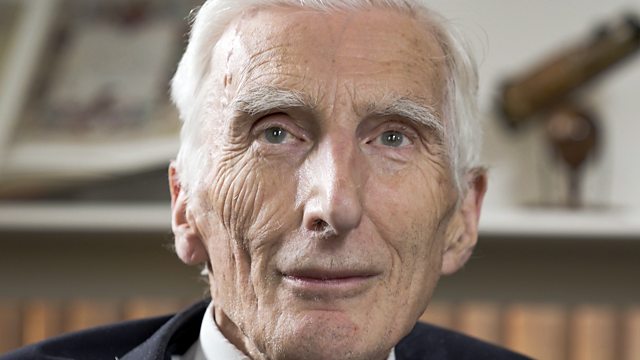
The Astronomer Royal at 80
Martin Rees is perhaps Britain鈥檚 most renowned cosmologist. Now, about to celebrate his eightieth birthday, Lord Rees talks to Chris Lintott about his career in science.
Martin Rees is perhaps Britain鈥檚 most renowned cosmologist. He was master of Trinity College, Cambridge, president of both the Royal Astronomical Society and the Institute of Physics, and has led the nation鈥檚 foremost science institution, the Royal Society. Now, about to celebrate his eightieth birthday, Lord Rees talks to Chris Lintott about his career in science.
Lord Rees says he wasn鈥檛 particularly interested in the night sky as a child and only pursued science at school because he found languages difficult. He also regretted reading maths at Cambridge, only finding his stride during his postgraduate studies, when he was taken on by Dennis Sciama to undertake research in astrophysics, leading to his PhD.
Rees鈥檚 career spans what he calls a 鈥榞olden age鈥� for astronomy. It began during a time when the origin of the universe was debated, when the flamboyant Fred Hoyle鈥檚 鈥榮teady state鈥� theory was eventually put to the sword by the bookish Martin Ryle, using the new technology of radio astronomy 鈥� in part aided and abetted by a young Martin Rees, whose work on quasars helped deal the fatal blow.
Rees was a contemporary of Stephen Hawking and witnessed at first hand the excitement of seeing black holes elevated from a speculative concept to an integral part of our universe鈥檚 evolution. Like many advances, including radio astronomy, it happened thanks to accidents in simultaneous progress. Work on radar during WWII led to advances in seeing the universe in non-visible wavelengths. Though they had been postulated in the 19th century, the reality of black holes arrived via Einstein鈥檚 theory of relativity, combined with radio astronomy and Roger Penrose鈥檚 genius for maths.
Time and again, over Rees鈥檚 career, seemingly bizarre ideas in cosmology have turned out to have merit. Rees and his colleagues showed that 鈥榙ark matter鈥� 鈥� a speculative 鈥榝ix鈥� for inconsistencies in galaxy dynamics 鈥� is also essential to the understanding of how the early universe found form, giving the concept increased credibility.
One of science鈥檚 most celebrated thinkers and writers, Rees has never been shy of engaging with difficult concepts. While the 鈥榖ig bang鈥� solved the question of our origin story, it also raises other questions such as 鈥榳hat was there before the big bang?鈥�, and Rees enjoys considering the possibility that there are other universes, perhaps with the properties of our universe that gave rise to us, or perhaps wholly or partially different.
Lord Rees also discusses the search for extraterrestrial intelligence, noting that while complex life may arise or has arisen in the universe, the likelihood is that, given the massive timescales involved, we are almost guaranteed to co-exist. But this leads to the intriguing prospect that any intelligent civilisation, including our own, is likely to create artificial intelligences that will supersede us and may well be near-immortal.
While Lord Rees worries about the threats that AI and the misuse of technology poses to our civilisation, he sees a potentially bright future in terms of scientific discovery, citing international collaborations and technological advances that might see us answering some of the questions we consider today to be too difficult - like the start of the universe and black holes used to be not so long ago.
Last on

Clip
-
![]()
Starguide: June 2022
Duration: 05:24
Music Played
Timings (where shown) are from the start of the programme in hours and minutes
-
![]() 00:01
00:01Royal Philharmonic Orchestra, Thomas Beecham
At The Castle Gate From Pelleas and Melisande (The Sky At Night) (1955)

Credits
| Role | Contributor |
|---|---|
| Presenter | Chris Lintott |
| Presenter | Maggie Aderin |
| Presenter | Pete Lawrence |
| Production Coordinator | Carisse Perks |
| Production Manager | Kassi Murphy |
| Assistant Producer | Marina Hui |
| Executive Producer | Steve Crabtree |
| Series Producer | Peter Leonard |
Join our photo group
Share images, inspiration and tips with fellow photographers