The Fish-Tetrapod Transition
Melvyn Bragg and guests discuss the great evolutionary change that gave rise to all the land animals on Earth with a backbone, when some fish developed limbs, lungs and necks.
Melvyn Bragg and guests discuss one of the greatest changes in the history of life on Earth. Around 400 million years ago some of our ancestors, the fish, started to become a little more like humans. At the swampy margins between land and water, some fish were turning their fins into limbs, their swim bladders into lungs and developed necks and eventually they became tetrapods, the group to which we and all animals with backbones and limbs belong. After millions of years of this transition, these tetrapod descendants of fish were now ready to leave the water for a new life of walking on land, and with that came an explosion in the diversity of life on Earth.
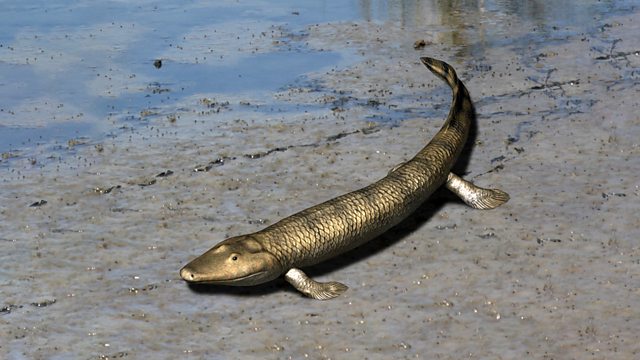
The image above is a representation of Tiktaalik Roseae, a fish with some features of a tetrapod but not one yet, based on a fossil collected in the Canadian Arctic.
With
Emily Rayfield
Professor of Palaeobiology at the University of Bristol
Michael Coates
Chair and Professor of Organismal Biology and Anatomy at the University of Chicago
And
Steve Brusatte
Professor of Palaeontology and Evolution at the University of Edinburgh
Producer: Simon Tillotson
Last on

LINKS AND FURTHER READING
READING LIST
R. Carroll, The Rise of Amphibians: 365 Million Years of Evolution (The John Hopkins University Press, 2009)
Jennifer Clack, Gaining Ground: The Origin and Evolution of Tetrapods (second edition, Indiana University Press, 2012)
R. Cloutier et al, 鈥楨lpistostege and the origin of the vertebrate hand鈥� (Nature 579, 2020)
M. Coates, 鈥楾he Devonian tetrapod Acanthostega gunnari Jarvik: postcranial anatomy, basal tetrapod interrelationships and patterns of skeletal evolution鈥� (Transactions of the Royal Society of Edinburgh: Earth Sciences 87, 1996)
M. Coates, M. Ruta and M. Friedman, 鈥楨ver Since Owen: Changing Perspectives on the Early Evolution of Tetrapods鈥� (Annual Reviews in Ecology, Evolution, and Systematics 39, 2008)
T. Halliday, Otherlands (Allen Lane, 2022)
E. Jarvik, 鈥楾he Devonian tetrapod Ichthyostega鈥� (Fossils & Strata 40, 1996)
M. MacIver, L. Schmitz, U. Mugan, T. D. Murphy and C. Mobley, 鈥楳assive increase in visual range preceded the origin of terrestrial vertebrates鈥� (Proceedings of the National Academy of Sciences, 2017)
B. Meyer-Berthaud and A.-L. Decombeix, 鈥業n the shade of the oldest forest鈥� (Nature 483, 2012)
L. C. Sallan and M. I. Coates, 鈥楨nd-Devonian extinction and a bottleneck in the early evolution of modern jawed vertebrates鈥� (Proceedings of the National Academy of Sciences 107, 2010)
R. R. Schoch, Amphibian Evolution: The Life of Early Land Vertebrates (Wiley-Blackwell, 2014)
Neil Shubin, Your Inner Fish: The amazing discovery of our 375-million-year-old ancestor (Penguin, 2009)
Carl Zimmer, At the Water鈥檚 Edge: Fish with Fingers, Whales with Legs, and How Life Came Ashore but Then Went Back To The Sea (Touchstone, 1999)
Broadcasts
- Thu 20 Oct 2022 09:00麻豆社 Radio 4
- Thu 20 Oct 2022 21:30麻豆社 Radio 4
Featured in...
![]()
Prehistoric—In Our Time
Browse the Prehistoric era within the In Our Time archive.
![]()
Science—In Our Time
Scientific principles, theory, and the role of key figures in the advancement of science.

In Our Time podcasts
Download episodes from the huge In Our Time archive.
The In Our Time Listeners' Top 10
If you鈥檙e new to In Our Time, this is a good place to start.
Podcast
-
![]()
In Our Time
Misha Glenny and guests discuss the ideas, people and events that have shaped our world.
