Lawnmowers
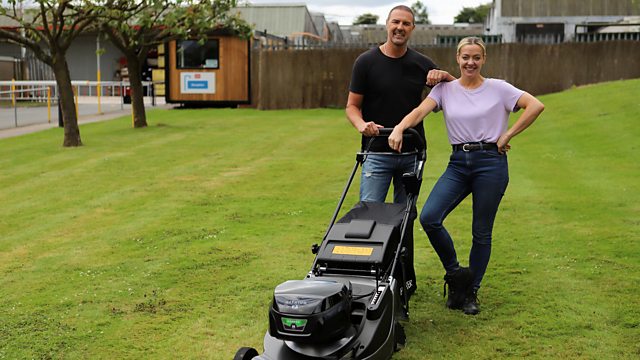
Paddy McGuinness and Cherry Healey enjoy a summertime visit to a factory in Hertfordshire that produces 15,000 lawnmowers every year.
Paddy McGuinness explores the secrets of Hayter lawnmowers at their factory in Hertfordshire, learning how they produce 15,000 mowers a year. They have been making the machines since the 1940s, so they certainly can cut it when it comes to mower construction. Paddy is following production of the Harrier 56 petrol-powered lawnmower.
Production begins with the delivery of the aluminium body of the mower, called the deck. Paddy meets design engineer Richard Carter, who tells him that it is made from aluminium rather than steel so that it doesn鈥檛 rust. But before they can continue with the process, Paddy has a confession to make 鈥� he doesn鈥檛 have real grass at home but an artificial lawn! Richard hopes he can change his mind, so they crack on and head to the painting area where Paddy dons a protective suit complete with breathing apparatus, leaving him looking like a cross between Buzz Aldrin and a Tellytubby.
Once the aluminium decks have been cleaned and primed, Paddy grabs a spray gun and helps to coat them, not with traditional paint but with a green plastic polymer powder, which provides a strong weather-resistant coating. Paddy makes a pretty good job of it, finding it quite therapeutic. With the spraying fun over, Paddy鈥檚 decks travel through an enormous oven, which blasts them with 300-degree Celsius heat, melting the powder coating and giving a glossy, tough finish.
With the decks painted, Paddy and Richard wheel them over to the main assembly line, where a team of highly skilled workers busily attach over 80 separate components at different workstations. Paddy鈥檚 first job is to attach the 159cc petrol engine, which will ultimately power a rotary cutting blade and propel the mower forward. It takes just three toughened steel bolts to connect the motor. Then the front axle and a chute are attached to help direct the grass cuttings into the collection bag.
A key feature of many lawnmowers is the roller that creates a classic striped lawn. Stepping away from the assembly line, Paddy learns from Richard how the roller components are cut out by a laser and welded together before being attached to the rear of the mower. Then on goes the cutting blade, which is designed to rotate at 2,800 revolutions per minute, slicing cleanly through the grass.
To make the most of filming in the summer, Paddy heads outside the factory building to the test lawn, where Richard has a finished mower waiting for him to learn the science of stripes. Paddy says he has been on plenty of test tracks but never a test lawn! According to Richard, the best height to cut the grass for good-looking stripes is four to six centimetres. Paddy sets the height of the cut and fires the engine into life, heading off down the test field. His stripes are not exactly what you would call straight, but he can clearly see the results. Richard tells him that the stripe is all about how light reflects off the blades of grass. The striping roller bends the blades over in one direction. The blades facing away from Paddy reflect more sunlight and so look light in colour, while the blades that face him reflect less sunlight, making them look darker.
Heading back inside the factory, Paddy helps to fit the final components to his mowers, before he is joined by co-presenter Cherry Healey for the grand reveal. Cherry gives the team a hand boxing the new mowers up, and they leave the factory on the back of a lorry, heading all over the UK and Ireland to make lawn-proud people happy. And as Paddy and the factory workers head back out to the test lawn, he concludes that there is only one way in his book to test a lawn: a game of footie!
Elsewhere in the episode, Cherry has exclusive access to Wembley Stadium, where she learns how they prepare the pitch for the biggest game of the season, the FA Cup final. And she heads to the University of Cambridge to learn how they have turned one of their formal lawns into a haven for wildlife. Historian Ruth Goodman unearths the history of the vast lawn at Blenheim Palace and learns how hovercraft technology propelled a famous orange mower into the gardens of Britain.
Last on

More episodes
Previous
Next
Coming soon
Clip
-
![]()
The secret to a perfectly striped lawn
Duration: 01:57
Credits
| Role | Contributor |
|---|---|
| Presenter | Paddy McGuinness |
| Presenter | Cherry Healey |
| Presenter | Ruth Goodman |
| Production Manager | Laura Johnstone |
| Executive Producer | Lucy Carter |
| Executive Producer | Michael Rees |
| Production Company | Voltage TV |

Learn more about the history of the factory and how it has evolved with an interactive from The Open University.
The fascinating stories behind the production of some of our favourite products.