Concorde: The Future We Flew Away From
Fifty years on from its first commercial flight, Rory Sutherland asks why Concorde was created. Were we actually more in love with the idea of supersonic travel than the reality?
Everyone thinks they know Concorde. The champagne鈥� the glamour鈥� the mach numbers鈥he delta wing and droop-snoot鈥� and Phil Collins doing two concerts in one day for Live Aid.
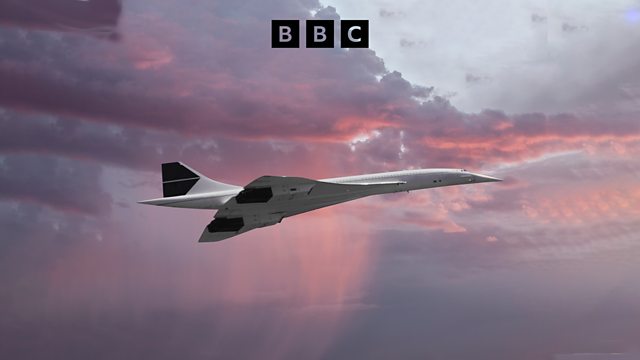
Concorde was an instantly recognisable aeroplane - a beautiful, streamlined dart which could fly a hundred passengers across the Atlantic faster than a rifle bullet.
But for behavioural science guru Rory Sutherland, Concorde isn鈥檛 just an aircraft. For him it was also a hugely expensive experiment in human psychology. It was about what we think we need contrasted with what we actually want. In this Archive on 4, marking the 50th anniversary of its first commercial flight, Rory discovers that Concorde satisfied a hunger which had nothing to do with transport.
When it was first mooted in the 1950s it was meant to usher in an exciting, new, supersonic age. Yet fifty years after that first commercial flight 鈥� and nearly 25 years after its last 鈥� Rory asks why we still fly to New York more slowly than the generation before us. Rather than a sparkling new era of supersonic travel, was Concorde always doomed to be just a brief, fever dream? Were we actually more in love with the idea of supersonic travel - and what it represented - than the reality?
As he explores the broadcast archive, Rory considers just what the Concorde story says about us, as a society, as a nation, as human beings. He discovers a story of pride and propaganda, inspiration and aspiration. Our obsession with speed accelerated in the early 20th century when the 100 mph barrier was first broken by a racing driver and the Futurist Manifesto was published by the Italian poet F.T. Marinetti. The Manifesto celebrated machinery and industry, youth, progress and, above all, speed. In the succeeding decades, human beings pushed the boundaries of technology to travel faster and faster, culminating in Concorde. But often the reason for pushing those boundaries was simply 鈥渂ecause we can鈥�.
Rory also considers Concorde as an exercise in nation-building. In the wake of the Second World War, as Britain鈥檚 empire and influence waned, it needed a way to signal 鈥� both abroad and at home - that it was still a world-beater. And creating the world鈥檚 first supersonic airliner seemed a perfect way to do that.
Rory turns to the archive to compare it with another project which was almost exactly concurrent with the development of Concorde - the United States鈥� Apollo programme to put a man on the Moon. At the height of the Cold War, President Kennedy needed a big statement to reassert his nation on the world stage and an astronaut planting an American flag in lunar soil was the very biggest.
Concorde halved the time it took to fly from London to New York. But Rory asks what we actually achieve by 鈥渟aving time鈥�. Did any business ever stand or fall by being able to cross the Atlantic in three hours rather than seven? Or was it more about prestige for those who could pay - or whose companies could pay - for a ticket on the Speedbird?
Along the way we meet Concorde鈥檚 pilots, passengers and crew, its supporters, its detractors and those who see it as a valuable lesson. With new supersonic ventures emerging just as climate politics tell us to slow down, we revisit Concorde to understand what we learnt from our experiment with supersonic passenger travel. The archive reveals the truth we never said out loud - Concorde proved we can go faster, but it also proved we have absolutely no idea why we want to.
Presenter: Rory Sutherland
Producer: Jeremy Grange
Executive Producer: Michael Surcombe
An Overcoat Media production for 麻豆社 Radio 4
Last on

Broadcast
- Sat 28 Feb 2026 20:00麻豆社 Radio 4