Dr Elizabeth Harris - 06/11/2021
Thought for the Day
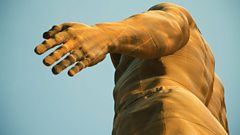
Good morning. Standing tall beside the harbour wall of the North Devon seaside town of Ilfracombe is Verity- Truth - a 66 foot statue of a pregnant woman by Damien Hirst. Her left hand holds a sword high into the air. The right is dropped behind her back and grasps a twisted set of scales of justice. There鈥檚 a foetus inside her, waiting to be born into an unjust world.
Today thousands of people will be taking part in a Global Day for Climate Justice to coincide with COP 26. In Britain, Canada, the Caribbean, Kenya, Mexico, to name but a few of the countries, people will be on the streets. 鈥楾he Era of Injustice is Over鈥� the promotional literature declares in a defiant gesture of hope that the voices of those who march will be heard.
Even some of those who are at the table in Glasgow are struggling to be heard. The 麻豆社 website carries the words of a climate envoy at COP, representing the Marshall Islands, one of the most threatened atolls in the world. 鈥楽ome discussions are emotionally draining 鈥� when you have to negotiate with countries you know aren鈥檛 taking your survival into account,鈥� she says. Justice might be defined differently by her than by more powerful countries.
My life鈥檚 exploration of two religions, Buddhism and Christianity, teaches me that we should never assume that we possess the whole truth. Rather we should ever be struggling to understand more clearly. Buddhism teaches me that our deep-seated attachments and aversions as individuals and societies can hide from us where truth and justice lie. Christianity continually challenges me to remember that it鈥檚 those without power, those with fewer resources and a weaker voice, who might have the most to teach us about what we are overlooking or simply ignoring.
Justice can be a slippery term, interpreted in different ways by those with power and those with less. When slavery was abolished, compensation was given to the slave owners, not the slaves whose lives had been violently exploited. That was thought to be justice at the time. Now we rightly condemn this.
I can鈥檛 now, therefore, make the triumphalist statement that of course we all know where justice lies in our present crises. We may not. Future generations might condemn us because we could not see things as they truly are. But those twisted scales of justice need to be released. Personally I need the perspectives of both Buddhism and Christian faith as I march today in defiant, non-violent hope that those with power will really listen to those who have less.
Duration:
This clip is from

More clips from Thought for the Day
-
![]()
Rabbi Charley Baginsky - 09/06/2026
Duration: 03:02
-
![]()
The Right Reverend Dr David Walker - 08/06/2026
Duration: 02:54
-
![]()
Shaykh Ibrahim Mogra - 06/06/2026
Duration: 03:06
-
![]()
Rev Dr Sam Wells - 05/06/2026
Duration: 03:19