When money died: The world's worst inflation
Hungary, 1946, where prices doubled every 15 hours.
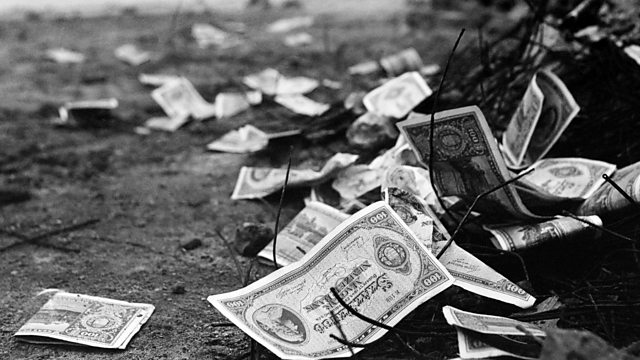
In the summer of 1946 inflation in Hungary reached 41.9 quadrillion per cent. That鈥檚 41.9 followed by 14 zeros 鈥� the highest rate of inflation ever recorded anywhere in the world. It meant prices of everyday goods and services doubled, on average, every 15 hours.
As the shattered country struggled to get to its feet after World War Two, weighed down by a Soviet occupation and punishing reparations, its government had little choice but to print more and more money, further fuelling the price spiral.
The hyperinflation stripped wages of almost all their value and plunged millions of Hungarians into a new fight for survival, but as they lost all faith in banknotes they turned to ever more inventive ways to trade and earn a living. We discuss how life for ordinary Hungarians changed amidst the chaos, what caused and eventually halted the economic disaster, and what the whole episode can tell us about the meaning of money.
Bridget Kendall is joined by B茅la Tomka, professor of modern social and economic history at the University of Szeged, in Hungary; L谩szl贸 Borhi, the Peter A Kadas Chair and associate professor in the Department of Central Eurasian Studies in the Hamilton-Lugar School at Indiana University, USA; and Pierre Siklos, professor of economics at Wilfrid Laurier University in Waterloo, Canada.
Producer: Simon Tulett
(Picture: Hungarian pengo banknotes lying on the ground in Budapest. Credit: Louis Foucherand/AFP via Getty Images)
Last on

More episodes
Broadcasts
- Thu 26 Jan 2023 10:06GMT麻豆社 World Service
- Fri 27 Jan 2023 00:06GMT麻豆社 World Service except South Asia
- Fri 27 Jan 2023 03:06GMT麻豆社 World Service South Asia
- Sun 29 Jan 2023 03:06GMT麻豆社 World Service East and Southern Africa & West and Central Africa only
- Sun 29 Jan 2023 14:06GMT麻豆社 World Service except East and Southern Africa & West and Central Africa
Podcast
-
![]()
The Forum
The programme that explains the present by exploring the past