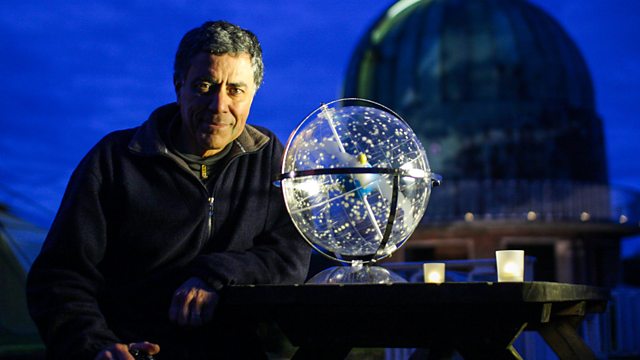
Seven Ages of Starlight
The story of the stars, from red giants and supernovae to black holes, and how discovering their tale has transformed our own understanding of the universe.
This is the epic story of the stars, and how discovering their tale has transformed our own understanding of the universe.
Once we thought the sun and stars were gods and giants. Now we know, in a way, our instincts were right. The stars do all have their own characters, histories and role in the cosmos. Not least, they played a vital part in creating us.
There are old, bloated red giants, capable of gobbling up planets in their orbit, explosive deaths - supernovae - that forge the building blocks of life and black holes, the most mysterious stellar tombstones. And, of course, stars in their prime, like our own sun.
Leading astronomers reveal how the grandest drama on tonight is the one playing above our heads.
Last on

![]()
The experts guide you through the wonders of the night sky
![]()
See what else is available now on iPlayer

Clips
-
![]()
Making a star on Earth
Duration: 02:05
-
![]()
Devouring red giants
Duration: 01:48
-
![]()
The birth of a black hole
Duration: 02:10


Music Played
-
![]()
Jean Rochefort
Youri Gagarine
-
![]()
Daniel Pemberton
The Awakening of Lizzie Siddal
-
![]()
David Lindup
Acquital
-
![]()
David Holmes
The Story Of The Ink
-
![]()
Florence + the Machine
Cosmic Love
-
![]()
Florence + the Machine
Cosmic Love
-
![]()
Bonde do Rol锚
Marina Gasolina (Crookers Remix)
-
![]()
Imogen Heap
Have You Got It In You
-
![]()
脫lafur Arnalds
Haegt, Kemur Ljosio
-
![]()
Imogen Heap
The Moment I Said It

A star is born

Adulthood
Red giants

White dwarfs
Supernovae
Neutron stars
Black holes
Credits
| Role | Contributor |
|---|---|
| Narrator | Rupert Graves |
| Executive Producer | Helen Thomas |
Broadcasts
- Thu 25 Oct 2012 21:00
- Fri 26 Oct 2012 02:05
- Mon 29 Oct 2012 23:00
 Sat 3 Nov 2012 20:15麻豆社 HD
- Tue 11 Jun 2013 21:00
- Sun 11 Aug 2013 21:00
- Wed 14 Aug 2013 00:30
- Sat 13 Sep 2014 22:25
- Tue 7 Jul 2015 21:45
- Wed 16 Mar 2016 21:00
- Wed 23 Nov 2016 00:00
- Sun 7 May 2017 22:50
- Sun 14 Apr 2019 19:00
- Mon 15 Apr 2019 02:25
- Wed 6 Jan 2021 23:00
- Sun 26 Sep 2021 23:00
- Mon 2 May 2022 19:30